Skip to content
A direct to garment printer places artwork directly on fabric. It helps businesses create custom clothing quickly. Today, brands want sharp photos, bright colors, and clean lines on t-shirts. Digital printing makes this task simple and fast.
Modern apparel printing equipment can handle complex artwork easily. Digital printers process photographic details without long setup times. Businesses can print small batches without losing quality.
Aura Sign Advertising supports printing businesses across the UAE. The company offers digital printing and cutting technology. Aura Sign Advertising supplies equipment from Mimaki, Roland, Epson, KingJet, MTuTech, and Zhongliqi. The company also provides full technical service and annual maintenance contracts (AMCs).
How a Direct to Garment Printer Processes Complex Designs
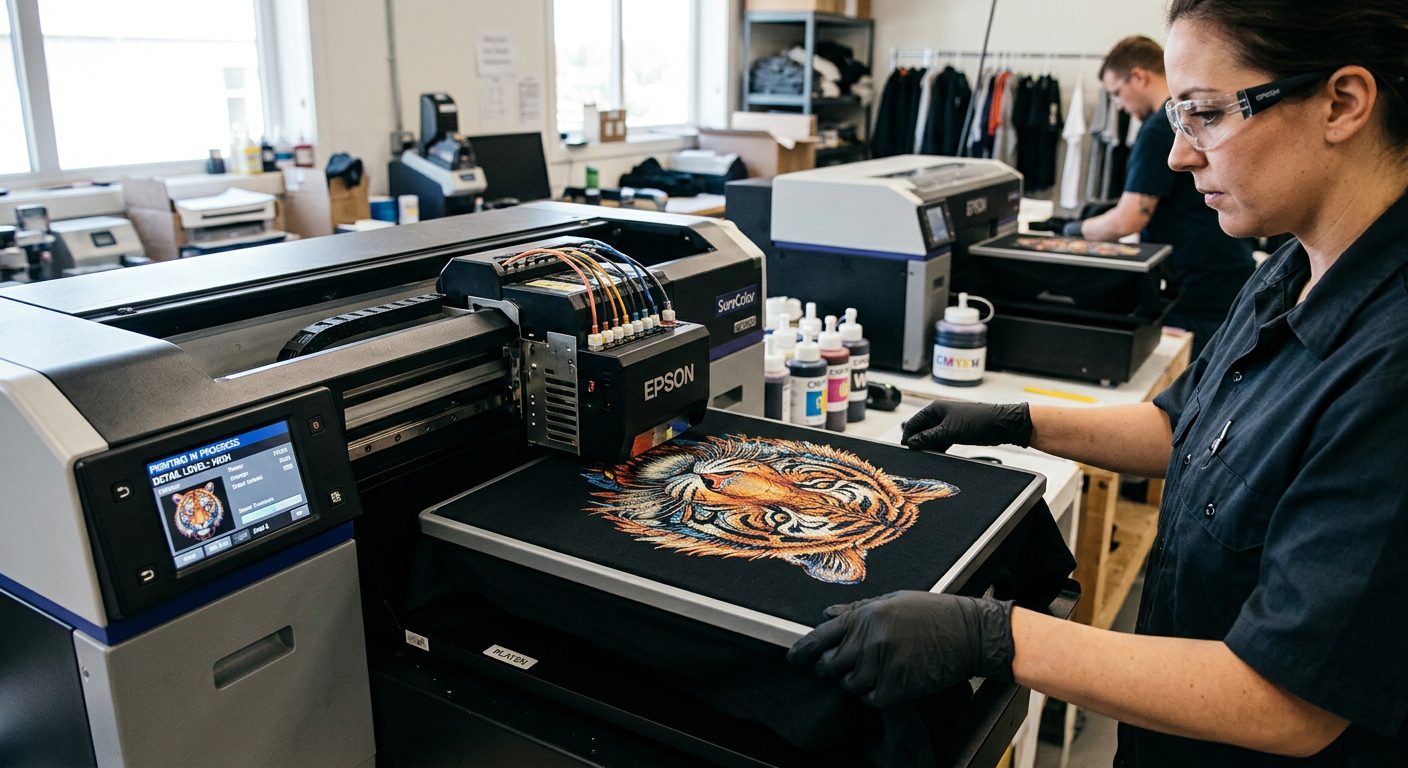
A direct to garment printer works like a standard inkjet printer. However, it applies specialized textile ink directly to fabric. The machine converts digital artwork into millions of tiny droplets. These ink droplets land on exact spots on the cloth.
Print heads move smoothly across the shirt platen. Advanced software controls every movement during production. The software calculates exact ink amounts for every part of the image.
The process follows simple, clear steps:
- First, you prepare the artwork on a computer.
- Next, you spray pretreatment liquid on dark shirts.
- Then, you place the garment flat on the platen.
- The machine prints a white ink base layer first.
- Color ink is printed directly over the white layer.
- Finally, heat cures the ink into the fabric fibers.
Managing Fine Lines and Micro Details
Fine lines appear often in logos, typography, and vector illustrations. A direct to garment printer reproduces thin lines when artwork resolution remains high. Clear files prevent blurry edges on the finished product.
Vector files work best for logos and sharp text. Vector shapes scale up without losing crisp edges. High-resolution raster images also yield great results on smooth cotton.
Fabric selection affects fine line clarity significantly. Smooth, tightly woven cotton holds fine details best. Rough fabrics can absorb ink unevenly and soften thin lines.
Testing artwork on actual shirt fabric saves time. Operators should print test swatches before running large orders. Test swatches help catch line thickness issues early.
Mastering Color Accuracy and Smooth Gradients
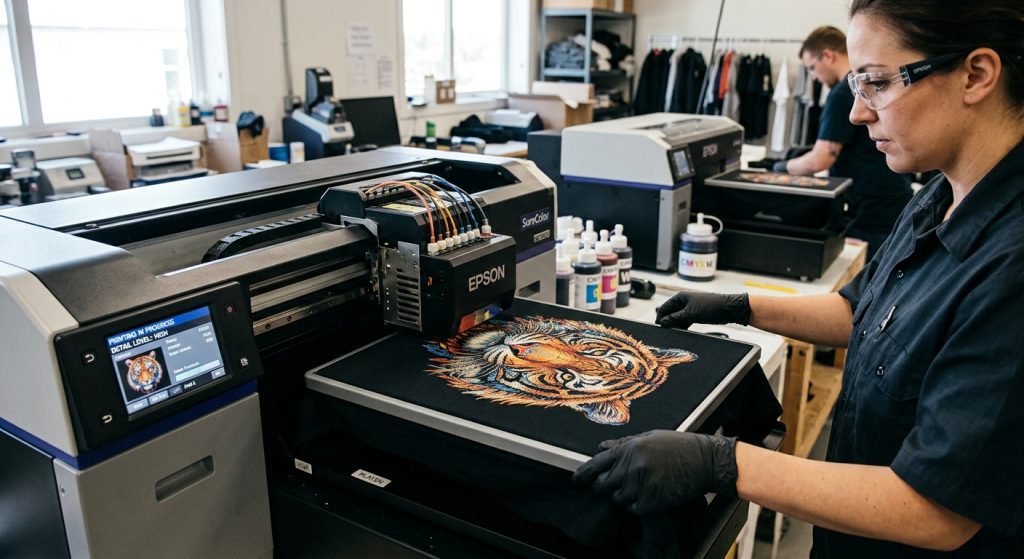
Color management keeps printed graphics looking vibrant and accurate. A direct to garment printer uses cyan, magenta, yellow, black, and white inks. Software blends these colors to match screen designs accurately.
White ink plays a critical role on dark garments. It forms a solid underbase on black t-shirts. Without white underbase ink, colorful graphics look dark and dull.
Gradients require soft color blending across the shirt surface. Digital print heads change droplet density to create smooth color fades. Fades look natural without blocky color bands.
Proper machine calibration keeps colors consistent between runs. Color profiles adjust ink levels for different fabric types. Operators should update color profiles whenever changing shirt materials.
Handling Photographs and Complex Shadows
Photographs contain millions of distinct shade variations. A direct to garment printer reproduces photographic images easily because digital files transfer directly to print software.
Shadows give depth to artwork and custom graphic designs. Digital print heads adjust ink density to render soft drop shadows smoothly. Dark areas remain clear without losing subtle background detail.
High-resolution photos produce superior final garments every time. Low-resolution images look pixelated when scaled up for shirt fronts. Designers must check file resolution before sending jobs to production.
Photographic t-shirts make popular promotional items for events. Custom photo prints also serve fashion brands and retail stores well. Digital printing allows short runs without high setup costs.
Choosing Fabrics for Maximum Graphic Sharpness
Fabric texture directly impacts graphic clarity and detail. Cotton fibers absorb water-based textile inks exceptionally well. Smooth cotton surfaces allow tiny ink droplets to land precisely.
Polyester blends require specialized print settings and pretreatment. Synthetic fibers absorb ink differently than natural cotton threads. Operators must adjust heat press settings for blended fabrics.
Garment preparation keeps fabric surfaces flat during printing. Wrinkles create dark lines and misaligned graphic details on shirts. Operators must smooth out every garment before pressing print.
Pretreatment liquid binds white ink to dark cotton fibers. Applying the correct pretreatment amount prevents color bleeding on dark t-shirts. Proper drying ensures smooth base layers for color ink.
Comparing Apparel Equipment to Other Digital Machines
Businesses often compare apparel printers with other digital machines. Every digital printing machine handles specific materials and production needs.
A sticker printing machine prints graphics on vinyl rolls and adhesive labels. It creates durable decals, packaging stickers, and window graphics. However, a sticker printing machine cannot print directly onto soft garments.
A uv printing machine cures ink instantly using ultraviolet light rays. A uv printing machine prints on rigid items like acrylic, wood, phone cases, and signs.
A printer for shirts focuses specifically on fabric decoration. A printer for t shirts allows custom garment production with soft ink feel.
| Equipment Type | Primary Material | Key Advantage |
| Direct to garment printer | Cotton t-shirts & apparel | Soft feel and detailed photographic prints |
| Sticker printing machine | Vinyl rolls & adhesive paper | Waterproof labels and custom decals |
| UV printing machine | Rigid signage & promotional items | Instant ink drying on hard surfaces |
| Printer for shirts | Various garments & textiles | Fast garment customization |
Preparing Artwork for a Direct to Garment Printer
Proper graphic preparation ensures smooth production runs. Designers must set image files to correct dimensions and print resolutions.
File setup guidelines for sharp garment graphics:
- Set file resolution to 300 DPI at actual print size.
- Use transparent backgrounds for non-rectangular designs.
- Convert thin text fonts to outlines or vector paths.
- Remove stray background pixels around graphic edges.
- Save final artwork as high-resolution PNG or TIFF files.
Clear artwork preparation prevents common printing mistakes. High-quality digital graphics lead directly to clear fabric prints.
Testing files on actual garments validates artwork choices quickly. Sample prints show exact color reproduction on target fabric colors.
Machine Maintenance for Consistent Detail Quality
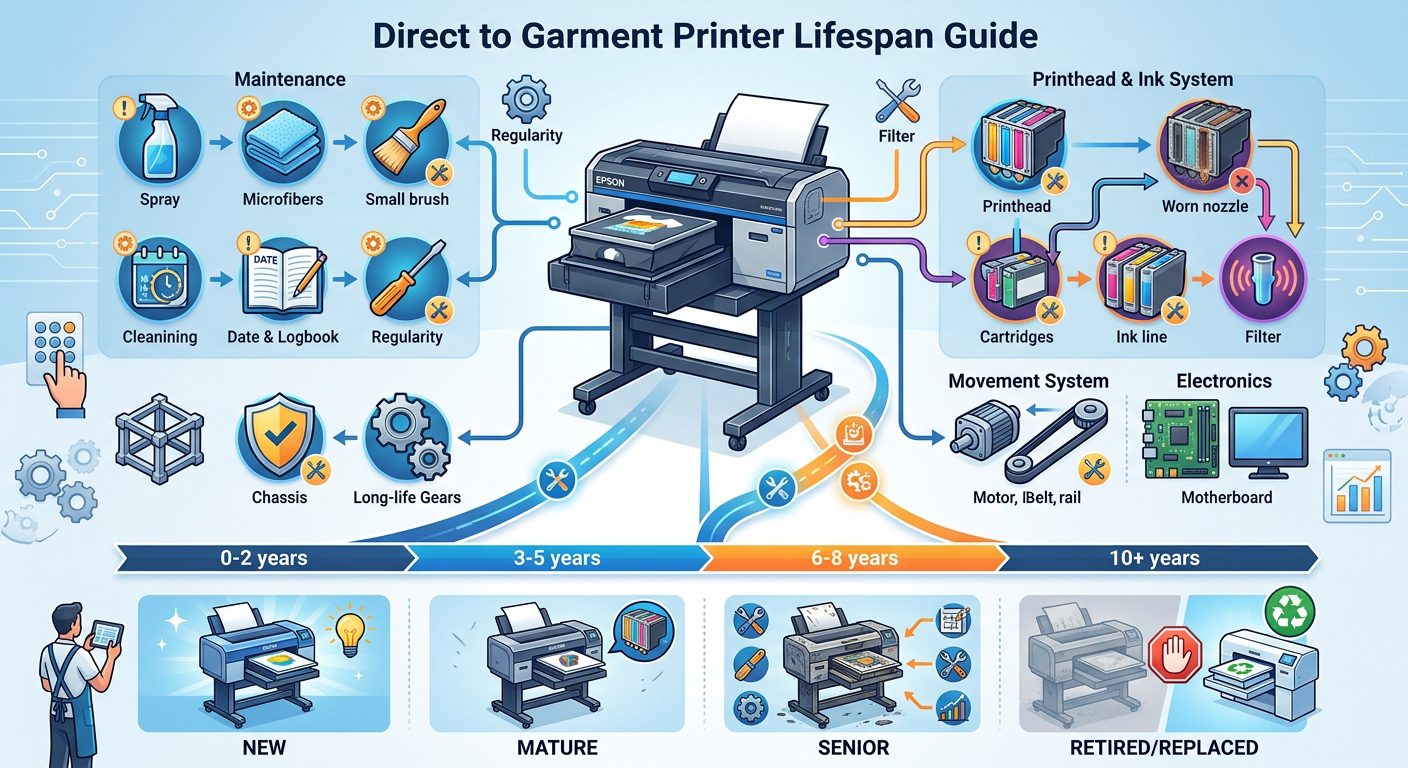
Print head maintenance keeps ink flowing through small nozzle openings. Blocked print nozzles cause streaks, missing lines, and dull colors on garments.
Daily cleaning routines protect sensitive print head components. Operators should wipe wiper blades and cap tops regularly. Clean parts keep ink droplets uniform during high-speed printing.
Aura Sign Advertising supports digital printing businesses throughout the UAE. The company provides complete technical support, spare parts, and machine maintenance. Their team services leading brands like Mimaki, Roland, Epson, KingJet, MTuTech, and Zhongliqi.
Annual maintenance contracts (AMCs) prevent unexpected machine downtime. Regular service prolongs print head life and maintains sharp printing quality. Reliable technical support keeps production schedules running smoothly.
For businesses expanding into promotional items, signage, and corporate gifts, services from Izra UAE complement direct digital garment production. Izra UAE provides custom corporate branding and promotional solutions.
Troubleshooting Common Detailed Graphic Issues
Print errors happen when file prep or maintenance falls short. Identifying root causes helps operators fix print problems quickly.
Blurry edges occur when source files have low resolution. Using 300 DPI files eliminates pixelated lines on t-shirts.
Dull colors on dark garments point to insufficient white ink base layers. Increasing white ink density restores brightness on dark fabrics.
Horizontal lines across graphics signal clogged print head nozzles. Running a head cleaning cycle clears blocked nozzles and restores smooth coverage.
Incorrect garment placement creates shifted graphic prints. Flattening shirts on the platen prevents image distortions and dark creases.
Business Applications for Custom Apparel Printing
Custom shirt printing supports many profitable business models. Small clothing brands launch custom collections without large inventory costs.
Promotional product suppliers print branded shirts for corporate events. Custom t-shirts help companies market their services effectively during trade shows.
Sports teams and school groups order custom apparel regularly. Digital printing allows individual names and numbers on every shirt.
Personalized gift shops print custom photo t-shirts for customers quickly. Short-run production keeps unit costs low for single custom orders.
Commercial print shops expand their service offerings by adding textile printers. Offering shirt printing attracts new corporate clients and revenue streams.
Selecting the Right Equipment for Your Business
Choosing printing equipment depends on target materials and volume. Businesses must evaluate their daily production goals carefully before buying machines.
A printer for t shirts suits businesses focused exclusively on apparel. Print shops needing adhesive decals should choose a sticker printing machine. Sign shops printing rigid boards require a uv printing machine.
A direct to garment printer delivers soft, detailed graphics on cotton apparel. Investing in the right technology boosts shop productivity and print quality.
Aura Sign Advertising guides UAE print service providers toward optimal machine choices. Their experienced team offers machinery, supplies, and after-sales support. Partnership with trusted equipment suppliers ensures long-term business success.
Conclusion
A direct to garment printer handles complex artwork, fine lines, and smooth gradients directly on fabric. Digital technology allows print service providers to produce custom t-shirts quickly without high setup costs. High-resolution artwork, proper fabric selection, correct pretreatment, and routine maintenance ensure crisp graphic reproduction. Aura Sign Advertising provides advanced equipment, original supplies, and reliable technical service across the UAE to support print businesses.