KYOCERA PRINTHEAD FAMILY
A technical breakdown of the world’s leading industrial piezoelectric inkjet ecosystem, driven by fine ceramic innovation and micro-fluidic mastery.
The Monolithic Advantage
Kyocera’s EX Series utilizes a single monolithic piezoelectric ceramic plate. Unlike segmented actuators, this 116mm continuous substrate eliminates boundary seams, ensuring perfectly uniform acoustic waves across the entire 108mm print swath.
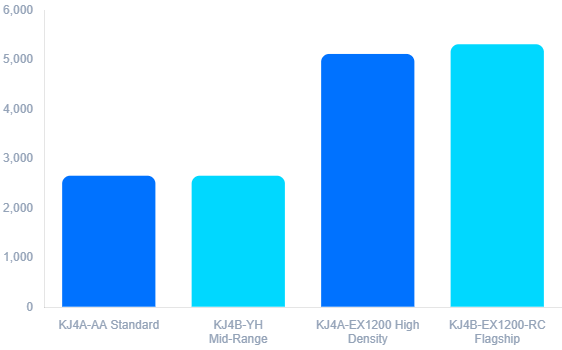
Comparison of nozzle density across major KJ4 generations. The EX1200 architecture nearly doubles the channel capacity of standard industrial heads.
Taxonomy & Nomenclature
The KJ4 platform uses a standardized naming convention to define fluid compatibility and mechanical capability. Understanding this syntax is vital for system integration.
The Physics of Frequency vs. Mass
The Inverse Law
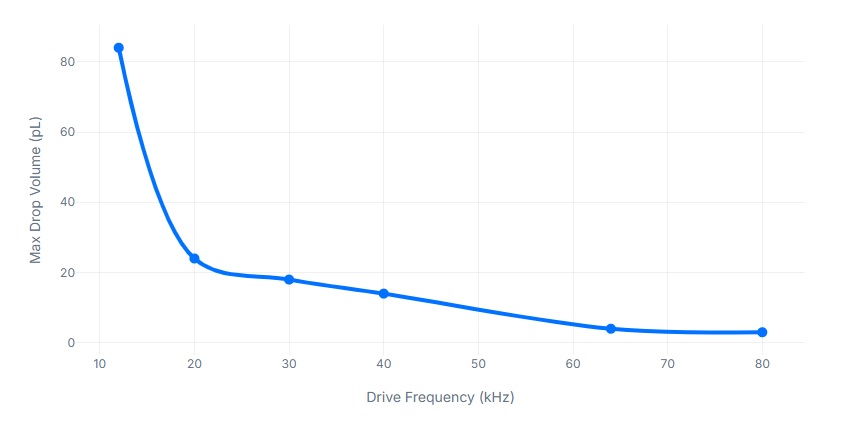
As the drive frequency (kHz) increases, the time for acoustic refilling decreases. This chart illustrates the critical trade-off between speed and drop volume.
- 40 kHz Limit Max drop mass capped at 14pL to prevent chamber starvation.
- 20 kHz Mode Allows volume expansion up to 24pL for heavy coverage.
Nozzle-Level Recirculation (RC)
Unlike manifold circulation, Kyocera’s RC tech moves fluid directly behind the nozzle orifice. This prevents sedimentation of heavy pigments (like White TiO2) and eliminates nozzle drying.