Industrial Print Diagnostics
Vertical Banding: The Diagnostic Blueprint
Deconstructing the mechanical, thermodynamic, and chemical disruptions in roll-to-roll eco-solvent printing to eliminate artifacts and maximize yield.
The Taxonomy of Bands
Before initiating hardware intervention, a technician must classify the visual character of the banding. Vertical bands are rarely random; their physical appearance acts as a forensic signature of the root cause—whether it be localized friction, heater failure, or media rejection.
Visual Character vs. Primary Suspect
Frequency of correlation based on technical diagnostic data.
Thermodynamics & Dot Gain Control
Eco-solvent printing is a thermal process. Inks are chemically balanced to land on a substrate that has been pre-heated to open its pores, then flash-cured to lock pigment in place. Any variance in the thermal lane—exceeding a 3°C delta—will manifest as a vertical lane of saturated (cold) or matte (hot) ink.
Ideal 3-Stage Thermal Profile
Standard Celsius targets for optimal PVC adhesion and dot coalescence.
Vacuum Pressure vs. Friction
Friction drag increases exponentially with vacuum pressure, leading to "suction drag" banding where media buckles into platen ribs.
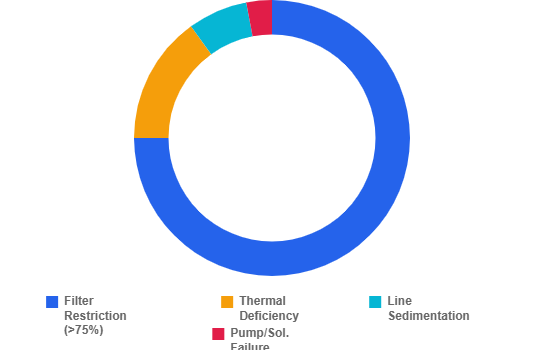
Root Cause Distribution
Statistical analysis of resolved service calls reveals that vertical banding is rarely a printhead failure. Instead, it is a complex interaction between mechanical tracking and thermodynamic stability.
Systematic Diagnostic Protocol
Follow this hierarchy of investigation to isolate variables without blindly replacing expensive components.
Alcohol Wipe Test
Clean a 10cm vertical strip with IPA. If banding vanishes in the zone, the issue is **Plasticizer Migration**.
Vacuum Reduction
Decrease vacuum by 20-30%. If bands change position, media was buckling into vacuum channels.
Roller Inspection
Deep clean rubber rollers. Look for flat spots or oil buildup from "substrate sweating."
Thermal Mapping
Use an IR Gun. A ΔT > 3°C across the platen indicates defective heater elements.
Nozzle Check
Examine for deflecting nozzles. Angled firing creates consistent vertical streaks.
Static Elimination
Neutralize charges with copper tinsel. Static paths pull ink droplets into "mist lanes."